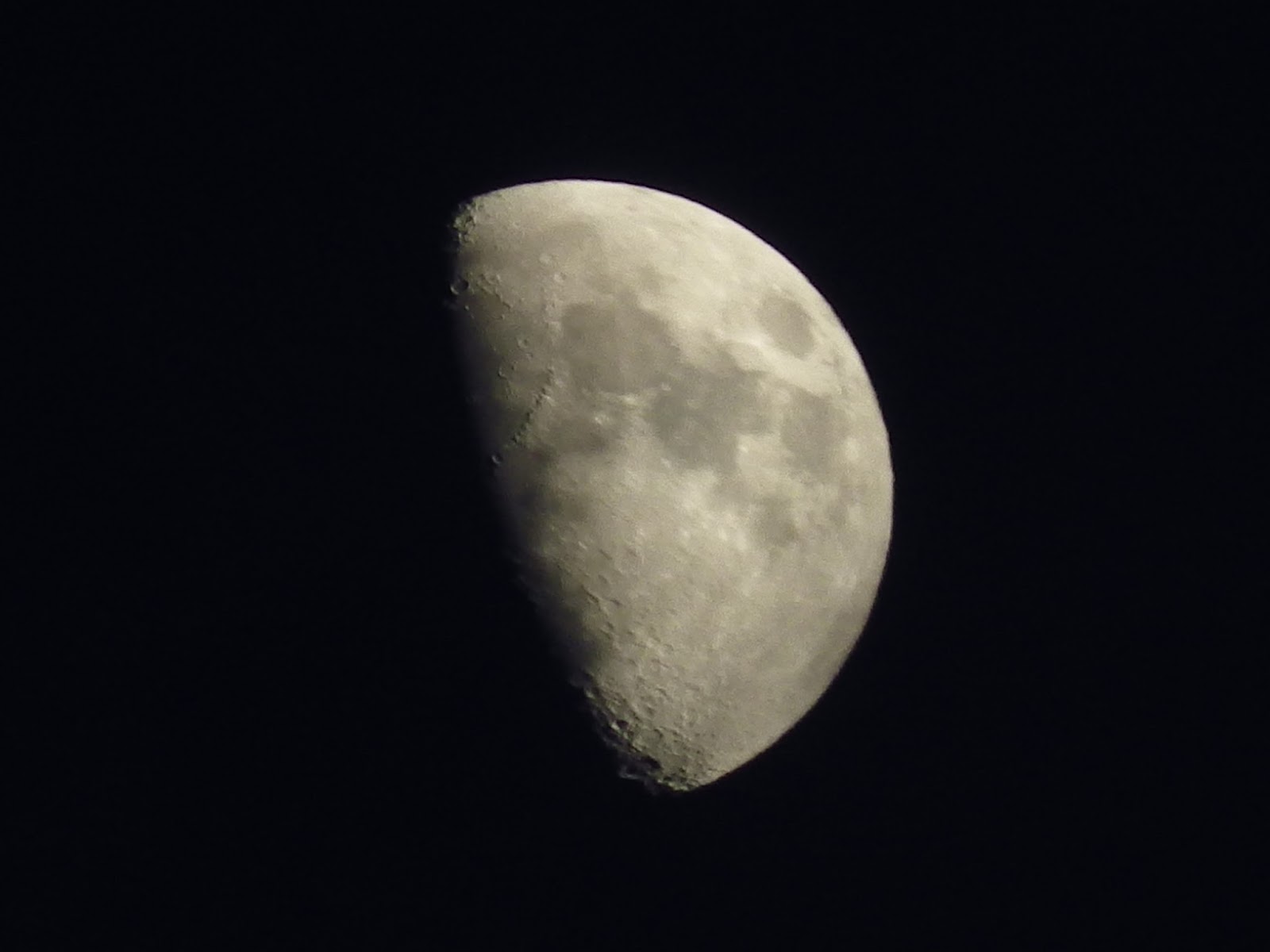
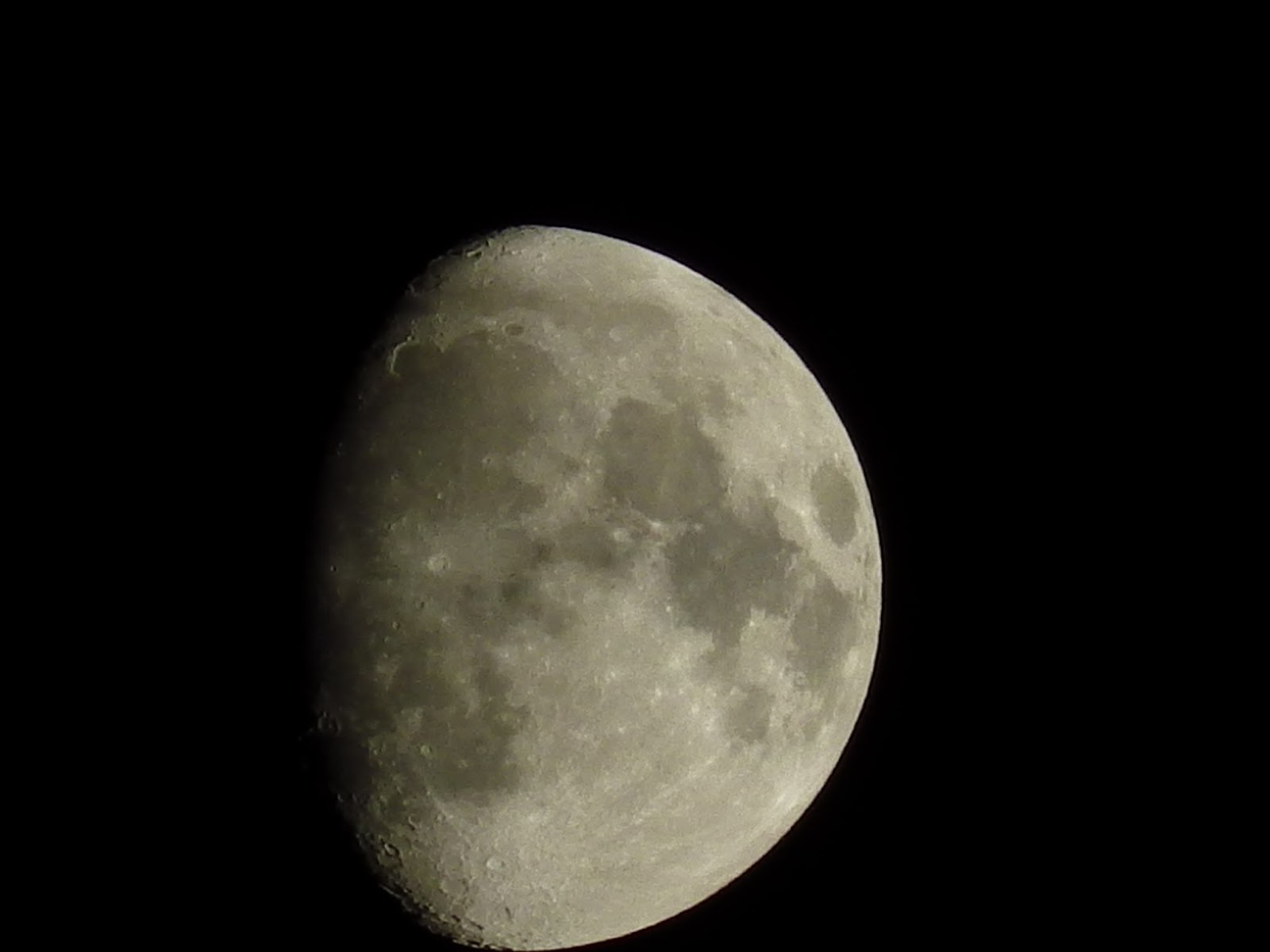
A great full Moon (first photo) but look how bright Jupiter is! It's a great time for seeing Jupiter; the second to fifth photos show it on 30th April, 2nd May, 4th May and 21st May 2018. BUT because it looks so small, it's difficult to get a sharp image with just a normal bridge camera; you need a tripod or something like that to get one!
(30th April 2018)
Time 21:13.
Distance 241,920 miles.
Full moon phase.
115 degrees SE compass point (azimuth).
Altitude 1.3 degrees.
Look at the Moon! Astronomy & our satellite... Photos of the Moon at key times of the month. Will it change? Keep looking in to watch our Moon!
Saturday, 26 May 2018
Moon 22nd May 2018
These are two Moons spread over 30 minutes with the camera in a fixed
position on a tripod. The Moon hasn't rotated much but it has moved
across the sky and in an arc! This is because the Earth is rotating much
faster than the Moon.
(left / right Moon)
Time 19:17 / 19:54.
Distance 233,274 / 233,274 miles.
First quarter / first quarter phase.
165 / 180 degrees S / S compass point (azimuth).
Altitude 46.6 / 47.2 degrees.
(left / right Moon)
Time 19:17 / 19:54.
Distance 233,274 / 233,274 miles.
First quarter / first quarter phase.
165 / 180 degrees S / S compass point (azimuth).
Altitude 46.6 / 47.2 degrees.
Sunday, 29 April 2018
Thursday 26th April 2018
Only the second Moon this month.
April last year I managed nine posts!
Lots of cloud - look how fuzzy the Moon looks.
Time 21:15.
Distance 235,482 miles.
Waxing gibbous phase.
150 degrees SE compass point (azimuth).
Altitude 37.8 degrees.
April last year I managed nine posts!
Lots of cloud - look how fuzzy the Moon looks.
Time 21:15.
Distance 235,482 miles.
Waxing gibbous phase.
150 degrees SE compass point (azimuth).
Altitude 37.8 degrees.
Wednesday 25th April 2018
I did an experiment to compare:
optical zoom vs. digital zoom!
Optical zoom is supposed to give better detail than digital zoom. However, the picture would be smaller.
If you enlarge the optical zoom picture in Photoshop to the same size as the digital zoom image then the pixels look a lot bigger.
But the optical zoom picture looks more '3D' - the shadows are much clearer.
Perhaps this could be because the digital zoom picture is more sensitive to camera shake. Who knows?
(for both photos)
Time 20:20.
Distance 233,750 miles.
Waxing gibbous phase.
150 degrees SE compass point (azimuth).
Altitude 42.0 degrees.
Sunday, 1 April 2018
1st April 2018
Spring Equinox / Easter
For Easter (spring equinox), I have put together a composite of three moons (25th November, 3rd December and 8th January).
I'm trying to show the old pagan Triple Goddess idea, where waxing moon represented birth, full moon represented life and waning moon represented death/rebirth.
Even back in the neolithic and beyond, people understood there was connection between the Moon and nature. But because they didn't have the science to explain it, they thought the Moon was a sort of spirit.
Their old idea of looking after the Moon and the environment is still important today.
Thursday, 29 March 2018
Monday 26th & Wednesday 28th March 2018
The way the light is falling on the Moon creates shadows that makes
Copernicus look 3D on the 26th but lack of shadow makes it look flat on
the 28th.
Time 19:30 / 20:15.
Distance 229,360 / 230,514 miles.
Waxing gibbous / waxing gibbous phase.
140 degrees SE compass point / 125 degrees SE compass point (azimuth).
Altitude 49.7 / 38.4 degrees.
Time 19:30 / 20:15.
Distance 229,360 / 230,514 miles.
Waxing gibbous / waxing gibbous phase.
140 degrees SE compass point / 125 degrees SE compass point (azimuth).
Altitude 49.7 / 38.4 degrees.
Sunday, 25 March 2018
Sunday 25th March 2018
Six moon sightings March last year but this is only the second this March.
I did see the Moon last week but only briefly and I didn't have my camera.
Time 18:40.
Distance 229,522 miles.
First quarter phase.
140 degrees SE compass point (azimuth).
Altitude 51.8 degrees.
Weather: Partly cloudy and breezy.
Temperature: 8 degrees (feels like 6 degrees).
Humidity: 57%.
Pressure: 1015 mb.
Visibility: Very Good.
Precipitation: 0%.
Wind Speed: 8mph.
Wind Direction: NNW.
Tuesday, 13 March 2018
Wednesday 7th March 2018
The only moon so far this month - weather warning - snowy & rainy skies!
A big morning moon.
Time 07:40.
Distance 244,715 miles.
Waning gibbous phase.
225 degrees SW compass point (azimuth).
Altitude 12.2 degrees.
A big morning moon.
Time 07:40.
Distance 244,715 miles.
Waning gibbous phase.
225 degrees SW compass point (azimuth).
Altitude 12.2 degrees.
Friday, 2 March 2018
Moon 28th February 2018
Below zero night Moon.
Time 21:15.
Distance 226,946 miles.
Waxing gibbous phase.
135 degrees SE compass point (azimuth).
Altitude 43.4 degrees.
https://youtu.be/0QTfSGkivCY
Time 21:15.
Distance 226,946 miles.
Waxing gibbous phase.
135 degrees SE compass point (azimuth).
Altitude 43.4 degrees.
https://youtu.be/0QTfSGkivCY
Friday, 9 February 2018
Moon 7th & Moon 8th February 2018
Consecutive morning Moons. Lovely blue sky but still fair detail.
I couldn't see the Falcon Heavy on its test flight though. It's the idea of Elon Musk and his SpaceX company and it has the heaviest payload of any current rocket and he's hoping to do commercial flights at a cost of $1,000/lb ($2,200/kg). What would you like to send into space?
(Wednesday 7th / Thursday 8th)
Time 08:30 / 07:45.
Distance 245,397 / 428,211 miles.
Last quarter / Last quarter phase.
220 degrees S compass point / 200 degrees SW compass point (azimuth).
Altitude 17.3 / 42.7 degrees.
Live stream video here:
https://www.youtube.com/watch?v=aBr2kKAHN6M
Saturday, 3 February 2018
Moon 31st January & Moon 1st February 2018
I didn't see the SUPER BLUE BLOOD MOON eclipse because it was the wrong time of day and the weather wasn't great either.
BUT, I did see it post-eclipse later that day and then a SUPERMOON the day after!
I also did a quick video to show the cloudy weather we have been having recently.
(31st January / 1st February)
Time 23:30 / 23:45.
Distance 224,555 / 224,553 miles.
Full moon / Waning gibbous phase.
150 degrees SE compass point / 140 degrees SE compass point (azimuth).
Altitude 49.7 / 42.7 degrees.
Tuesday, 30 January 2018
Moon 30th January 2018
Red sky in the morning, shepherd's warning!
Nothing to do with the Moon, but a great sky this morning (07:40).
SUPER BLUE BLOOD MOON
Really impressive Moon yesterday.
First 2 photos were taken at 4 o'clock - lovely blue sky but the Moon really shone out.
Last 2 photos later during the evening & night. Great detail; and you can easily see the rotation.
This is building up to the...
!!! SUPER BLUE BLOOD MOON !!!
...on January 31st - first time since 1982!
1 - Supermoon - when it's closest to the Earth; looks very big and bright.
2 - Blood Moon (lunar eclipse) - when the Earth goes between the Sun and the Moon; the Moon looks red because of how the light goes through the atmosphere.
3 - Blue Moon - the 2nd full moon in a month.
But I probably won't be able to see it because the weather forecast here tomorrow is rain and cloud.
Date Monday 29th January 2018
Time 16:00.
Distance 223,190 miles.
Waxing gibbous phase.
72 degrees E compass point (azimuth).
Altitude 10.9 degrees.
Friday, 26 January 2018
Moon 26th January 2018
Moooo! You can't beat a bit of Bully.
And tonight the Moon passes the brightest star in the constellation Taurus the Bull - Aldebaran. You should be able to see it, just be careful of the Moon's glare.
The Pole Star nowadays is Polaris but IT USED TO BE Aldebaran!
Not only that, it was half of a DOUBLE POLE STAR, with capella.
This was a long time ago - 450,000 years ago.
Time 16:01.
Distance 229,204 miles.
Waxing gibbous phase.
110 degrees E compass point (azimuth).
Altitude 33 degrees.
http://earthsky.org/tonight/moon-aldebaran-ex-pole-star
Tuesday, 23 January 2018
Moon 23rd January 2018
The image is a bit blurred, partly because of the rain, cloud and rain, but also because I had to take this quickly and I had to lean out of the window.
Time 17:15.
Distance 238,918 miles.
Waxing crescent phase.
180 degrees S compass point (azimuth).
Altitude 39.6 degrees.
Time 17:15.
Distance 238,918 miles.
Waxing crescent phase.
180 degrees S compass point (azimuth).
Altitude 39.6 degrees.
Saturday, 13 January 2018
3rd December 2017
Here's a video from December that I didn't have time to post.
It's a great full moon but look at how much cloud there was and how fast it was moving.
Time 23:31.
Distance 222,212 miles.
Full moon phase.
160 degrees S compass point (azimuth).
Altitude 53.9 degrees.
(https://youtu.be/QTkYfTeNMj8)
Sunday 7th January 2018 - half past midnight
I was very late coming back from seeing a friend and followed this great Moon on the way home!
Because of the tilt of the Moon you can clearly see what I think are the Montes Pyrenaeus and Sinus Asperitatis to the east of Mare Nectaris ("Sea of Nectar").
Time 00:30.
Distance 235,365 miles.
Waning gibbous phase.
110 degrees SE compass point (azimuth).
Altitude 19.9 degrees.
Because of the tilt of the Moon you can clearly see what I think are the Montes Pyrenaeus and Sinus Asperitatis to the east of Mare Nectaris ("Sea of Nectar").
Time 00:30.
Distance 235,365 miles.
Waning gibbous phase.
110 degrees SE compass point (azimuth).
Altitude 19.9 degrees.
Wednesday, 10 January 2018
Moon 1st & 2nd January 2018
Two whoppers to start the year!
1st:
Time 20:38.
Distance 221,566 miles.
Full moon phase.
120 degrees SE compass point (azimuth).
Altitude 39.5 degrees.
2nd:
Time 22:52.
Distance 222,372 miles.
Full moon phase.
130 degrees SE compass point (azimuth).
Altitude 47.8 degrees.
1st:
Time 20:38.
Distance 221,566 miles.
Full moon phase.
120 degrees SE compass point (azimuth).
Altitude 39.5 degrees.
2nd:
Time 22:52.
Distance 222,372 miles.
Full moon phase.
130 degrees SE compass point (azimuth).
Altitude 47.8 degrees.
Monday, 1 January 2018
Moon 31st December 2017
Hogmanay Moon.
What a whopper to end the year!
Happy new year.
Time 21:52.
Distance 222,128 miles.
Waxing gibbous phase.
150 degrees SE compass point (azimuth).
Altitude 53.7 degrees.
What a whopper to end the year!
Happy new year.
Time 21:52.
Distance 222,128 miles.
Waxing gibbous phase.
150 degrees SE compass point (azimuth).
Altitude 53.7 degrees.
Friday, 29 December 2017
Moon 28th December 2017
Two photos, one hour apart, and the Moon appears to have rotated nearly 20 degrees clockwise.
But this is an optical illusion. The reason it appears to have rotated is because we look at the moon at different angles! This is because both the Earth and Moon are rotating anti-clockwise but the Moon rotates about 30 times slower.
Here is a video that may help!
https://www.youtube.com/watch?v=OZIB_leg75Q
(first photo, 21:30 / second photo, 22:31)
Distance 230,421 / 230,421 miles.
Waxing gibbous phase / waxing gibbous phase.
207 degrees SW compass point / 246 degrees SW compass point (azimuth).
Altitude 43.4 / 38.3 degrees.
Thursday, 28 December 2017
Moon 27th December 2017
First moon after Christmas!
So I chose the nearest moon landing to Christmas Day to talk about which is Luna 13. It landed on Christmas Eve 1966, in the region of Oceanus Procellarum, the only 'ocean" on the Moon! It sent panoramic TV pictures on Christmas Day, and its last contact was 51 years ago today!
Back to my Moon photo, look at how it has rotated (compared to my 2nd October 2017 photo).
1, Mare Tranquillitatis
2, Tycho
3, Montes Apenninus or Apennines
Time 22:39.
Distance 234,323 miles.
Waxing gibbous phase.
240 degrees SW compass point (azimuth).
Altitude 27.5 degrees.
Tuesday, 26 December 2017
Moon 15th December 2017
Last Moon before Christmas.
It was an early, cold, clear, bright morning. Wonderful distinct silhouette of the Moon and Terminator but no detail.
Have a nice Christmas.
Time 07:35.
Distance 250,027 miles.
Waning crescent phase.
145 degrees SE compass point (azimuth).
Altitude 17.2 degrees.
It was an early, cold, clear, bright morning. Wonderful distinct silhouette of the Moon and Terminator but no detail.
Have a nice Christmas.
Time 07:35.
Distance 250,027 miles.
Waning crescent phase.
145 degrees SE compass point (azimuth).
Altitude 17.2 degrees.
Sunday, 10 December 2017
Sunday 10th December 2017
Compare this to the previous post: same time, same place, different day, no Moon.
All astronomers until 1965 had the problem of weather stopping them from investigating space. But in 1965, the Russians launched Proton-1, the first orbital telescope, which worked on gamma rays. The first optical telescope was Hipparcos, by the European Space Agency in 1989.
Time 10:32.
Distance 236,811 miles.
Last quarter phase.
250 degrees W compass point (azimuth).
Altitude 20.6 degrees.
-1 degrees C.
Wind speed 13 mph.
NNE wind direction.
Humidity 97%.
Poor visibility.
Barometer 976mbars.
Saturday, 9 December 2017
Saturday 9th December 2017
Snowy Moon!
I was riding my sledge today in the park and I could see the Moon!
The photo doesn't show any detail (I only had my small camera) but at least it's there!
Time 11:12.
Distance 233,162 miles.
Last quarter phase.
270 degrees W compass point (azimuth).
Altitude 10.7 degrees.
2 degrees C.
Humidity 80%.
Barometer 1020 mbars.
Tuesday, 5 December 2017
Moon 29th October 2017 & Moon 29th November 2017
What a difference a month makes!
Same moon, one calendar month apart. The Terminator is slightly further left in November and the October Moon appears brighter.
Historic weather report shows 29th October to be "scattered clouds", 4 degrees C, humidity 85%, barometer 1010 mbars, whilst 29th November was "passing clouds", 0 degrees C, humidity 86%, barometer 997 mbars.
29th October 2017:
Time 17:50.
Distance 243,498 miles.
Waxing gibbous phase.
150 degrees SE compass point (azimuth).
Altitude 20 degrees.
29th November 2017:
Time 18:26.
Distance 232,709 miles.
Waxing gibbous phase.
140 degrees SE compass point (azimuth).
Altitude 32.2 degrees.
Saturday, 28 October 2017
Moon 27th October 2017
Look at how much more of the Moon we can see in 48 hours. The first photo shows the shape of the on the 25th overlaid in a transparent green colour on the Moon of the 27th. It is a little bit bigger so a whole lot better!
Time 18:50.
Distance 249,091 miles.
First quarter phase.
180 degrees S compass point (azimuth).
Altitude 18.5 degrees.
Friday, 27 October 2017
Moon 25th October 2017
Today is the 51st anniversary (1966) of Luna 12 going into lunar orbit!
It had a television system that took 1100-line photographs - about twice the resolution of the old UK television system!
It took pictures of the Sea of Rains and the Aristarchus crater, which you can't see in the photo so I've marked the locations.
We're not sure what happened to Luna 12 but we think it decayed from orbit and crashed into the Moon, location unknown.
Time 18:15.
Distance 251,626 miles.
Waxing crescent phase.
190 degrees S compass point (azimuth).
Altitude 16.1 degrees.
Saturday, 21 October 2017
Moon 5th October 2017
I'm a bit behind with this photo but it was the last time I saw the Moon - over 2 weeks ago!
2 days and 46 years since Luna 19 went into orbit around the Moon. It's a full moon now but if I had been standing here 46 years ago it would be a waning gibbous.
Now:
Time 23:00.
Distance 234,067 miles.
Full moon phase.
140 degrees SE compass point (azimuth).
Altitude 32.3 degrees.
1971:
Distance 221,726 miles.
Waning gibbous phase.
120 degrees SE compass point (azimuth).
Altitude 38.8 degrees.
Sunday, 15 October 2017
Moon 2nd October 2017
Very cloudy at 7:15 (first two photos) but 2 1/2 hours later and the sky was clear!
You can see some of the features mentioned by Pete Lawrence in The Sky at Night programme (
@16:00 minutes):
1, Mare Tranquillitatis (where Apollo 11 landed)
2, Tycho (which is only 80km across but has some beautiful rays)
3, Montes Apenninus or Apennines
4, Archimedes
5, Autolycus
6, Aristillus
7, Reiner Gamma (which looks like an eye) (not visible in this photo!)
(first and second photos, 19:15 / third photo, 21:45)
Distance 240,323 / 240,323 miles.
Waxing gibbous phase / waxing gibbous phase.
130 degrees SE compass point / 165 degrees S compass point (azimuth).
Altitude 11.9 / 24.3 degrees.
The Sky at Night
The latest 'The Sky at Night' is really very good. It's about the Moon - 'Return to the Moon?'
It's still availiable to watch on the BBC iPlayer.
https://www.bbc.co.uk/iplayer/episode/b097xp51/the-sky-at-night-return-to-the-moon
It's still availiable to watch on the BBC iPlayer.
https://www.bbc.co.uk/iplayer/episode/b097xp51/the-sky-at-night-return-to-the-moon
Sunday, 8 October 2017
Moon 1st October 2017
Spot the Moon! Too much cloud.
Time 19:54.
Distance 243,510 miles.
Waxing gibbous phase.
150 degrees SE compass point (azimuth).
Altitude 17.3 degrees.
Time 19:54.
Distance 243,510 miles.
Waxing gibbous phase.
150 degrees SE compass point (azimuth).
Altitude 17.3 degrees.
Moon 29th September 2017
This time the sky's a bit wet but suprisingly you can see good detail.
The terminator is on Copernicus!
Time 19:31.
Distance 248,731 miles.
Waxing gibbous phase.
160 degrees S compass point (azimuth).
Altitude 17.2 degrees.
The terminator is on Copernicus!
Time 19:31.
Distance 248,731 miles.
Waxing gibbous phase.
160 degrees S compass point (azimuth).
Altitude 17.2 degrees.
Saturday, 7 October 2017
Moon 28th September 2017 & Moon 3rd October 2017
Happy 46th Anniversary to Luna 19!
The Luna 19 spacecraft was unmanned. It lanched on 28th September 1971 and went into orbit on 3rd October 1971 (although some sources say it was the 2nd!).
It investigated mascons in the Maria on the Moon. Mascons are unusual concentrations of mass on a planet or moon's surface.
It also studied the Sun's magnetic field, carried by the solar wind!
Instruments included a Gamma-ray spectrometer, cosmic-ray detectors and radiation detectors - wow!
This year's weather was very different to the weather in 1971. It looks like it was warmer and dryer in 1971. On the 28th, the Moon was very clear but on the 3rd it was cloudy. Look at those photos!
yyyy mmm max min rain sun
temp temp mm hours
1971 Sep 19.0 8.2 18.6 157.5
1971 Oct 15.7 6.0 59.1 142.0
2017 Sep 17.3 9.3 88.6 116.8
(source: www.metoffice.gov.uk , 1971 temperatures are mean max/mins)
(first photo, 28th September / second photo, 3rd October)
Time 19:40 / 23:45.
Distance 250,359 / 237,085 miles.
First quarter phase / waxing gibbous phase.
180 degrees S compass point (azimuth) (both photos).
Altitude 17.1 / 29.8 degrees.
Subscribe to:
Posts (Atom)