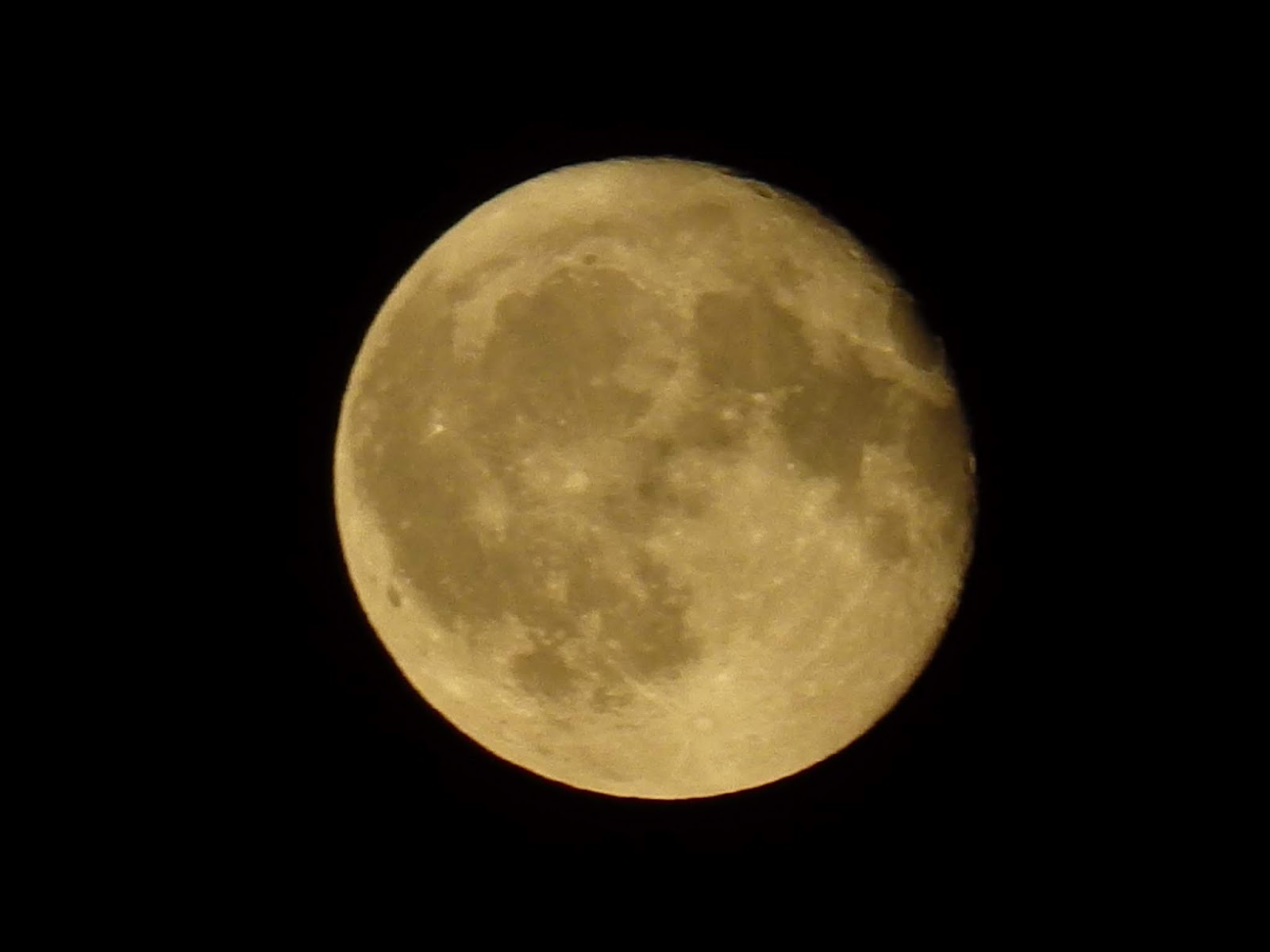
Thursday, 18 July 2019

Moon Thursday 18th July 2019

Apollo 11, 18th July 1969, CDR and LMP entered LM for initial inspection.


Tuesday, 16 July 2019

Moon Tuesday 16th July 2019

Apollo 11, 16th July 1969, Liftoff.


Moon Monday 15th July 2019

15th July 1969, Scheduled 11-hour hold at T-9 hours.

Time 22:30.
Distance 245,176 miles.
Waxing gibbous phase.
155 degrees S compass point (azimuth).
Altitude 10.2 degrees.


Monday, 15 July 2019

Moon Sunday 14th July 2019

 Apollo 11 Timeline, 14th July 1969, 21:00:00, Terminal Countdown started.

(1st / 2nd photos)
Time 20:45 / 23:25.
Distance 244,131 / 244,131 miles.
Waxing gibbous / waxing gibbous phase.
140 / 175 degrees SE / S compass point (azimuth).
Altitude 6.7 / 14.7 degrees.


Sunday, 14 July 2019

Moon Saturday 13th July 2019 - Jupiter

Jupiter is the fourth-brightest light in the sky, after the Sun, Moon and Venus.
It is also more than 1,700 times the Moon’s distance from Earth!

Time 21:30.
Distance 241,921 miles.
Waxing gibbous phase.
160 degrees S compass point (azimuth).
Altitude 15.0 degrees.


Moon Saturday 13th July 2019


Tomorrow 50 years ago, the Apollo 11 Terminal Countdown started, and this time next week 50 years ago, Apollo 11 landed on the Moon!

And today 50 years ago, Soviet Russia launched the unmanned Luna 15 to the Moon. They had to tell the USA the flight path so that it would not crash into Apollo 11. Unfortunately it crashed into the Moon instead.

In Britain you could have listened to the no.1 record on the radio, Thunderclap Newman's 'Something in the‏ Air'.
https://www.youtube.com/watch?v=k8zmkzshUvE

Or on BBC 1 you could have watched the Film Matinee starring Bing Crosby singing 'Don't let that moon get away'.
https://www.youtube.com/watch?v=MsSewdsqTqM

Time 21:30.
Distance 241,921 miles.
Waxing gibbous phase.
160 degrees S compass point (azimuth).
Altitude 15.0 degrees.


Friday, 24 May 2019

Moon Art


Here's some artwork in an Andy Warhol style of the four Moon photos I just posted. The artwork is based on Warhol's painting 'Sixteen Jackies' (1964). Zoom in to see each Moon's individual effects!


Moons Sunday 12th, Monday 13th, Tuesday 14th and Wednesday 15th May 2019

Four moons on four successive nights!
Despite being quite light nights, the spot exposure on the camera blacked everything out other than the Moon, and the angle of the light gave some great crater shadows!

Pick a feature of the Moon and see how much it rotates over the four nights!

(12th / 13th / 14th / 15th May)
Time 21:45 / 20:50 / 20:25 / 20:15.
Distance 229,535 / 229,295 / 229,494 / 230,205 miles.
Waxing gibbous / waxing gibbous / waxing gibbous / waxing gibbous phase.
215 / 175 / 155 / 140 degrees SW / S / SE / SE compass point (azimuth).
Altitude 46.3 / 46.1 / 38.1 / 28.0 degrees.


Monday, 6 May 2019

Moon Friday 19th April 2019 - Arty Moon!

I decided to do an arty picture of the Moon with a colourful artwork curve I drew.

First, I pasted in my art curve into Abode Photoshop and gave the colours a bit more vibrance.
Then, I put that in the Moon photo, before cutting out most of the mares (revealing a highly contrasted Moon beneath) and making the visible Moon surface stain-glassed.

Time 21:00.
Distance 228,102 miles.
Full moon phase.
115 degrees NE compass point (azimuth).
Altitude 5.5 degrees.


Monday, 22 April 2019

Saturday 20th April 2019 - Pink Moon!

The Pink Moon - the 'equivalent' of the Blood Moon, just not in an eclipse! Despite being called the Pink Moon, it isn't actually pink! The name comes from the bloom of ground phlox, a pink flower common to North America.

But why does it look different? Well, it is caused by particles (photons) in Earth's atmosphere. Because they scatter blue light better than red light, bluer photons get scattered (so the sky usually looks blue) but redder ones pass through the atmosphere.

So why do they always occur near the horizon? Well, because the light is travelling further through the atmosphere than when the Moon is high in the sky.

(1st / 2nd photos)
Time 21:09 / 22:46.
Distance 230,328 / 230,328 miles.
Waning gibbous / waning gibbous phase.
105 / 125 degrees E / SE compass point (azimuth).
Altitude -4.2 / 8.1 degrees.


Friday, 19 April 2019

Moon Thursday 18th April 2019

First Moon in nearly a month!

Time 23:00.
Distance 227,297 miles.
Waxing gibbous phase.
150 degrees SE compass point (azimuth).
Altitude 28.7 degrees.


Saturday, 23 March 2019

Moon Thursday 21st March 2019

Full supermoon on the March 2019 equinox - this is a vernal equinox - vernal from Latin 'vernus' meaning 'of the spring' and equinox from Latin meaning 'equality of night and day'.

This is the closest a full moon and the March equinox have come since March 2000! You will have to wait 11 years to get them less than a day apart again!

(In the Southern Hemisphere, this March full moon counts as your Harvest Moon. The Harvest Moon is the full moon occurring closest to the autumnal equinox.)

Time 22:35.
Distance 224,094 miles.
Full moon phase.
135 degrees SE compass point (azimuth).
Altitude 27.3 degrees.


Tuesday, 19 February 2019

Moon Monday 18th February 2019

A good photo but the details look flat because the sun is hitting the craters full on and there's no shadow!

I compared this photo with 18th November 2018 when the sun's light angle to the Moon made a terminator and great shadows, e.g. on the crater Copernicus.

Time 19:40.
Distance 221,774 miles.
Waxing gibbous phase.
100 degrees E compass point (azimuth).
Altitude 31.5 degrees.


Monday, 18 February 2019

Moon Friday 15th and Sunday 17th February 2019

In the evening the Moon was nearly above my house so it was difficult to get a good photo of out of my bedroom window!

(15th / 17th Feb)
Time 19:30 / 21:30.
Distance 228,472 / 222,928 miles.
Waxing gibbous / waxing gibbous phase.
150 / 150 degrees SE / SE compass point (azimuth).
Altitude 55.5 / 53.9 degrees.


Sunday, 10 February 2019

January Moons

Moon Wednesday 9th, Monday 14th and Wednesday 30th January

Because of the rainy and cloudy weather, I only managed 3 photos in January, and haven't had the chance to use the new telescope to take pictures. But the 3 photos I did get show three different phases!

(9th Jan / 14th Jan / 30th Jan)
Time 18:15 / 19:50 / 07:15.
Distance 252,295 / 242,490 / 245,056 miles.
Waxing crescent / first quarter / waning crescent phase.
225 / 205 / 170 degrees SW / SW / S compass point (azimuth).
Altitude 10.5 / 41.0 / 18.0 degrees.


Thursday, 27 December 2018

Xmas Telescope

This is my Christmas present, a Skywatcher BKP-1145-EQ1 Reflector telescope. It has two interchangeable eyepieces (25mm and 10mm), a Barrow Lens, a Red Dot Finder and a motor drive. Classic! Good photos of the Moon, here we come!

...but with the weather at the moment, I would have been better off with a Grey Cloudwatcher!


Wednesday, 26 December 2018

Moon 24th December 2018

At the time that the photo was taken, according to NASA's Santa Tracker, Father Christmas was heading from the Balkans into Italy! Did you see him?

Time 20:50.
Distance 249,915 miles.
Waning gibbous phase.
85 degrees E compass point (azimuth).
Altitude 20.7 degrees.


Moon 22nd December 2018


It was too cloudy for the winter solstice (the 21st)...
The day after (the 22nd), still cloudy so a great 'arty' photo...
And it cleared up later, so a proper detailed photo!
And it was a full moon, so HOWWWLLLLLLL!

Time 18:30 / 21:00.
Distance 226,230 / 226,230 miles.
Full moon / full moon phase.
80 / 110 degrees E / E compass point (azimuth).
Altitude 19.3 / 41.0 degrees.


Saturday, 15 December 2018

Moon 14th December 2018

The terminator is right on the 1971 Apollo 15 landing site, on the Hadley Rille in the Apennine region!

This was the first mission where the Lunar Roving Vehicle (the "Moon buggy") was used. Even though its top speed was meant to be about 8 mph, Eugene Cernan later hit 11.2 mph, making him the unofficial lunar land-speed record holder!

A recording of the Apollo 15 launch was included in the "Sounds of Earth" on Voyager 1, which is now 13.5 billion miles from Earth.

Time 16:45.
Distance 249,915 miles.
Waxing crescent phase.
160 degrees S compass point (azimuth).
Altitude 25.6 degrees.

Sunday, 25 November 2018

Moon 21st November 2018

A full moon! Bright and shiny!
But 12 hours later, it's a murky morning; is that sphere the Moon or the Sun?
Of course, being 12 hours later and the same place in the sky it cannot be the Moon!

Time 20:15.
Distance 234,978 miles.
Waxing gibbous phase.
130 degrees SE compass point (azimuth).
Altitude 37.4 degrees.


Sunday, 18 November 2018

Arecibo Moon (late!)

Really nice photo but...

...a day too late for the Arecibo Message 44th Anniversary!

By this time, 44 years ago, the message would have been 16.1 billion miles past the Moon! Yikes!

But it would still have had about 147,000 trillion miles to go!

I created a song to celebrate it.
https://soundcloud.com/samsswingnskank/arecibo-sound
(Full info on my other blog: http://samsswingnskank.blogspot.com/2018/11/arecibo-sound.html)

Time 18:30.
Distance 249,419 miles.
Waxing gibbous phase.
170 degrees S compass point (azimuth).
Altitude 24.3 degrees.


Saturday, 17 November 2018

Moon 11th November 2018

It's not only Remembrance Sunday and Armistice Day on the same day, but the Moon is exactly the same phase as it was 100 years ago!

There's a very bright star to the bottom right of the moon, but I'm not sure what it is as I only have a hand-held planisphere! There are a few possibilities but I think it might be Altair in the Aquila constellation - the 12th brightest star in the sky. From the Arabic for "the flying eagle", Altair isn't spherical, but flattened at the poles because it rotates very rapidly (286 km/s at the equator!).

Here are the Moon details:
Time 17:15.
Distance 247,883 miles.
Waxing crescent phase.
210 degrees SW compass point (azimuth).
Altitude 10.8 degrees.

Compare that with the results from 100 years ago at the same time:
Time 17:15.
Distance 234,773 miles.
Waxing crescent phase.
165 degrees S compass point (azimuth).
Altitude 25.0 degrees.


Thursday, 1 November 2018

Moon 30th October 2018

No visible Moon on Halloween because of the weather, but here's the Halloween Eve Moon!

On the northern horn of the terminator lies Anaxagoras, named after Greek philosopher Anaxagoras.

It's an impact crater made of anorthosite, an igneous rock.
Most Earth anorthosites formed during Precambrian times and it contains titanium-bearing ilmenite which is used by steelworkers in blast furnaces.

The crater is 32.25 miles across. Imagine if the meteorite that it had hit Dudley instead it would have formed a crater from Brignorth to the NEC!

Time 23:30.
Distance 230,436 miles.
Waning gibbous phase.
80 degrees E compass point (azimuth).
Altitude 15.1 degrees.


Tuesday, 30 October 2018

Moon 29th October 2018 Photo


Moon 29th October 2018

If the last post was 'all Greek' to you, here's Double Greek crater shadows!

Yes, I'm on about Eudoxus and Aristoteles (named after Eudoxus of Cnidus and Aristotle, both Greek astronomers) at the top of Montes Caucasus And even better, they're on the terminator!

The strange things about these craters is their shape. Eudoxus appears oval from Earth, but is really circular - an optical illusion! On the other hand, Aristoteles is a really strange rounded hexagonal shape!

Time 23:05 (GMT).
Distance 231,120 miles.
Waning gibbous phase.
80 degrees E compass point (azimuth).
Altitude 20.7 degrees.


Moon 19th and 20th October 2018

With the clear and frosty nights we have seen some great moons the past week.

But how much of the Moon do we actually see?

Here's a method I thought of to work it out, using the idea that you really have two circles - the Moon's circumference and the circle formed by extrapolating the Terminator arc.

Working out the diameter of the Moon easy because the terminator 'horns' are always at the 'top' and 'bottom', and after a bit of fiddling, you can work out the distance between the left/right edge of the moon and the nearest part of the terminator.
(Don't forget the most you can ever see of the Moon is 50%!)

Time 17:45 / 20:00 (GMT).
Distance 249,599 / 247,779 miles.
Waxing gibbous / Waxing gibbous phase.
130 / 145 degrees SE / SE compass point (azimuth).
Altitude 8.1 / 20.8 degrees.


Sunday, 7 October 2018

Moon 23rd to 26th September 2018


4 big moons over the 23rd to 26th September.
Great to look at but only a mad man would send a rocket to the moon on these dates; just look at the history!

23rd September 1958, 60 years ago, Soviet Russia launched the R-7 Semyorka 8K72; mission - hit the moon! Take off, tick tock, tick tock, 93 seconds, BANG!

One year later, 24th September 1959, USA launched Pioneer P-1. On the launch pad, BOOM!

Another year, 25th September 1960, Pioneer P-30 went 230 miles into the sky, lost power, WALLOP!

Six years on, 20th September 1966, Surveyor 2 was nearly there until engine malfunction... Cartwheel into Copernicus Crater, CRASH!

23rd September 1969, the anniversary of Semyorka 8K72, the Russian Kosmos-300 had engine failure leaving it LOST IN SPACE! Well, stranded in Earth orbit anyway. Unhappy Anniversary!


Saturday, 8 September 2018

Planets Synth.


Not strictly the Moon but...
    I was listening to a programme on Radio 4 about rhythms, and they used the orbits of the planets as a musical rhythm, so I decided to do the same using an oscillator synthesizer.

    I adapted my old synthesizer written in HTML and javascript that runs through a web browser.

    Firstly I worked out a frequency for each planet proportionally scaled on their distance from the Sun. Because of the huge distances of the outer planets I had to use a different scale for them.

    For the planets' beeps per minute, I worked out a proportional tempo based on the orbits. I found a good tempo for Mercury first (240bpm), then calculated the other planets based on that. Again because of the huge numbers, I have to use a separate tempo range for the outer planets, otherwise the inner ones would have been beeping too fast or the outer ones too slowly.

    Once I had that sounding good I thought it would be great to add modulation based on the number of large Moons each planet had, and also some delay.

    Here is the final result.


    Audio track for looping through a bass amp!

    BBC Radio 4.

    Monday, 30 July 2018

    Moon 27th July 2018

    It's the century's longest 'Blood Moon' lunar eclipse, when the Earth comes between the Sun and the Moon.

    T-minus 48 hours: big Moon
    T-minus 24 hours: big Moon
    Eclipse: No Moon! Too cloudy!

    Let's see what you could have seen:
    https://www.bbc.co.uk/news/science-environment-44945452

    Time 20:30.
    Distance 252,397 miles.
    Full moon phase.
    130 degrees SE compass point (azimuth).
    Altitude -4.6 degrees.

    Thursday, 26 July 2018

    Moon 24th July 2018

    Look at the bright spot in the bottom left; what is it?
    It's not Jupiter because that was to the right of the Moon.
    It's possibly Mars but that should appear red and this didn't.
    So it's probably either Saturn or the star Antares, the brightest light in the Scorpio constellation.
    Which do you think?

    Time 22:10.
    Distance 251,225 miles.
    Waxing gibbous phase.
    170 degrees S compass point (azimuth).
    Altitude 15.6 degrees.