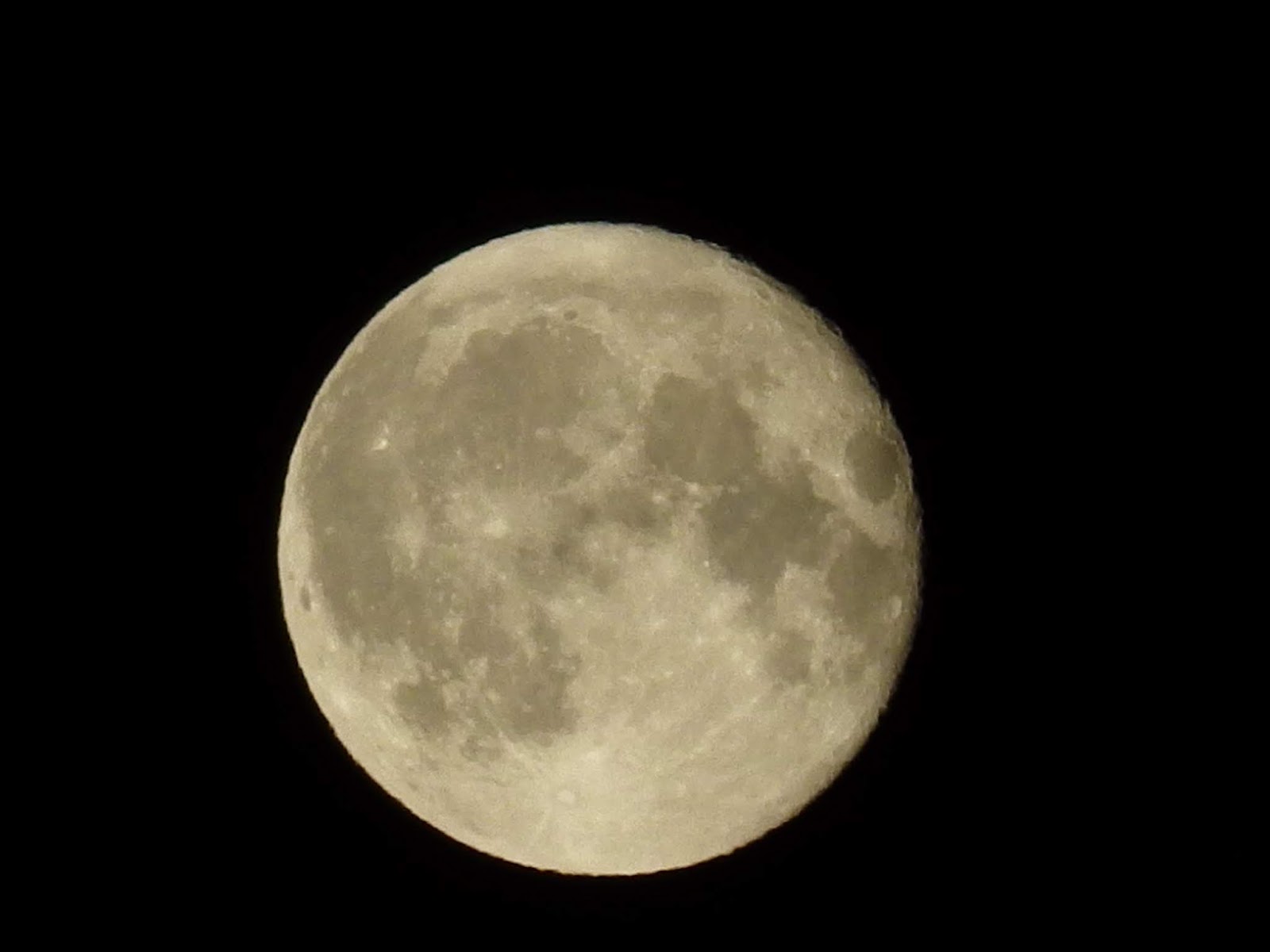
My homework was about forces acting upon a satellite so I chose the Moon! Here it is.
Even Pluto has a gravitational pull on the Moon because even though it is insignificant, gravitional pull never reaches zero.
And the American flag left by Neil Armstrong and Buzz Aldrin also has a weight force and a gravitational pull on the Moon! Well, in theory, anyway, even if it has probably disintegrated by now. Still not bad to consider a $5.50 flag made by Annin of New Jersey is still affecting a (theoretical) effect on the Moon!
Time 19:05.
Distance 244,648 miles.
Waxing gibbous phase.
165 degrees S compass point (azimuth).
Altitude 12.5 degrees.
Look at the Moon! Astronomy & our satellite... Photos of the Moon at key times of the month. Will it change? Keep looking in to watch our Moon!
Friday, 27 September 2019
Friday, 20 September 2019
Moon Thursday 19th September 2019
Morning Moon is back!
Time 09:00.
Distance 245,997 miles.
Waning gibbous phase.
260 degrees W compass point (azimuth).
Altitude 26.9 degrees.
Time 09:00.
Distance 245,997 miles.
Waning gibbous phase.
260 degrees W compass point (azimuth).
Altitude 26.9 degrees.
Sunday, 15 September 2019
Telescopic Moon
I have not found the best way to take a photo of the Moon through my telescope.
I have a clamp but no information of zoom, focus and exposure.
I tried this and whilst it's bright, there's some good detail: you can see raised features in the crater Ptolemaus (centre of terminator).
I have a clamp but no information of zoom, focus and exposure.
I tried this and whilst it's bright, there's some good detail: you can see raised features in the crater Ptolemaus (centre of terminator).
Double Full Moon - Moon Friday 13th and Saturday 14th September 2019
A clear and cloudy comparison!
In the second photo, the detail has been diffused, although it is still a reasonable image.
(first / second photos)
Date 13th Sep / 14th Sep.
Time 22:05 / 22:05.
Distance 252,436 / 252,471 miles.
Full moon / full moon phase.
135 / 125 degrees SE / SE compass point (azimuth).
Altitude 17.4 / 16.5 degrees.
In the second photo, the detail has been diffused, although it is still a reasonable image.
(first / second photos)
Date 13th Sep / 14th Sep.
Time 22:05 / 22:05.
Distance 252,436 / 252,471 miles.
Full moon / full moon phase.
135 / 125 degrees SE / SE compass point (azimuth).
Altitude 17.4 / 16.5 degrees.
Friday, 13 September 2019
Moon Wednesday 11th September 2019
Where's the Moon?
Time 20:23.
Distance 251,943 miles.
Waxing gibbous phase.
135 degrees SE compass point (azimuth).
Altitude 9.0 degrees.
Time 20:23.
Distance 251,943 miles.
Waxing gibbous phase.
135 degrees SE compass point (azimuth).
Altitude 9.0 degrees.
Tuesday, 10 September 2019
Moon Monday 9th September 2019 - Saturn!
Saturn again. Very easy to see with the naked eye in the early evening light.
Time 20:15.
Distance 249,420 miles.
Waxing gibbous phase.
155 degrees SE compass point (azimuth).
Altitude 11.7 degrees.
Time 20:15.
Distance 249,420 miles.
Waxing gibbous phase.
155 degrees SE compass point (azimuth).
Altitude 11.7 degrees.
Moon Monday 9th September 2019
Some really good photo effects again, by using the 'spot exposure' feature on the camera on either the moon or sky.
(all photos)
Time 20:15.
Distance 249,420 miles.
Waxing gibbous phase.
155 degrees SE compass point (azimuth).
Altitude 11.7 degrees.
(all photos)
Time 20:15.
Distance 249,420 miles.
Waxing gibbous phase.
155 degrees SE compass point (azimuth).
Altitude 11.7 degrees.
Sunday, 8 September 2019
Moon Friday 6th September 2019
Time 23:05.
Distance 241,456 miles.Waxing gibbous phase.
225 degrees SW compass point (azimuth).
Altitude 2.7 degrees.
Moon Thursday 5th September 2019 - Saturn!
Saturn was really easy to see - even on a light night!
(both photos)
Time 20:25.
Distance 237,854 miles.
Waxing crescent phase.
205 degrees S compass point (azimuth).
Altitude 14.3 degrees.
(both photos)
Time 20:25.
Distance 237,854 miles.
Waxing crescent phase.
205 degrees S compass point (azimuth).
Altitude 14.3 degrees.
Moon Thursday 5th September 2019
Monday, 2 September 2019
Moon Saturday 28th July 2018, Saturday 25th August 2018, Wednesday 26th September 2018 and Saturday 18th May 2019
Haven't seen many moons recently so here are some old moons.
Four fancy photogenic moons!
Cloudy or wet weather can make really good effects with my camera if you play with the settings and exposure.
My favourite is the 2nd photo (25th August) because of the navy blue sky and the white hot Moon! Which one is your favourite?
Date: 28th July / 25th August / 26th September / 18th May
Time: 23:25 / 20:40 / 20:50 / 23:30
Distance: 252,286 / 251,574 / 243,233 / 233,326 (miles)
Phase: Waning gibbous / waxing gibbous / waning gibbous / full moon
Degrees: 140 / 120 / 95 / 155
Compass: SE / SE / E / SE (azimuth)
Altitude: 12.1 / 4.1 / 7.4 / 17.2 (degrees)
Four fancy photogenic moons!
Cloudy or wet weather can make really good effects with my camera if you play with the settings and exposure.
My favourite is the 2nd photo (25th August) because of the navy blue sky and the white hot Moon! Which one is your favourite?
Date: 28th July / 25th August / 26th September / 18th May
Time: 23:25 / 20:40 / 20:50 / 23:30
Distance: 252,286 / 251,574 / 243,233 / 233,326 (miles)
Phase: Waning gibbous / waxing gibbous / waning gibbous / full moon
Degrees: 140 / 120 / 95 / 155
Compass: SE / SE / E / SE (azimuth)
Altitude: 12.1 / 4.1 / 7.4 / 17.2 (degrees)
Friday, 23 August 2019
The Spaceguard Centre
The Spaceguard Centre, in Knighton, Powys, is one of the world-leaders in NEO (Near-Earth Objects) research!
There were some telescopes, a mini-planetarium, a moving model of the Solar System and even some meteorite samples there - all on a guided tour! They even showed that new craters were being plotted on the Moon's surface every day!
I saw the mechanics of the telescope in the observatory - after going up the scary steep staircase!
All self-funded from the public and done by 1 astronomer! No help from government or the lottery - boo!
I would give it a rating of 9 out of 10 and I would definitely recommend it if you would fancy travelling up to the Welsh-English border!
https://spaceguardcentre.com/
Sunday, 18 August 2019
Moon Thursday 15th August 2019
A rainy night, with a hazy halo around the Moon.
Time 23:40.
Distance 251,132 miles.
Full moon phase.
150 degrees SE compass point (azimuth).
Altitude 16.8 degrees.
Time 23:40.
Distance 251,132 miles.
Full moon phase.
150 degrees SE compass point (azimuth).
Altitude 16.8 degrees.
Moon Monday 12th August 2019
A clear night, so good detail.
Time 21:20.
Distance 248,283 miles.
Waxing gibbous phase.
155 degrees SE compass point (azimuth).
Altitude 10.6 degrees.
Time 21:20.
Distance 248,283 miles.
Waxing gibbous phase.
155 degrees SE compass point (azimuth).
Altitude 10.6 degrees.
Moon Sunday 11th August 2019
A cloudy night; you could see them in front of the Moon!
A great atmosperic shot.
Time 23:40.
Distance 246,293 miles.
Waxing gibbous phase.
195 degrees S compass point (azimuth).
Altitude 12.6 degrees.
A great atmosperic shot.
Time 23:40.
Distance 246,293 miles.
Waxing gibbous phase.
195 degrees S compass point (azimuth).
Altitude 12.6 degrees.
Saturday, 17 August 2019
Moon Friday 16th August 2019
Some great detail tonight. The clouds created a great arty effect just after.
Time 23:45.
Distance 251,974 miles.
Waning gibbous phase.
140 degrees SE compass point (azimuth).
Altitude 17.0 degrees.
Time 23:45.
Distance 251,974 miles.
Waning gibbous phase.
140 degrees SE compass point (azimuth).
Altitude 17.0 degrees.
Sunday, 11 August 2019
Moon Saturday 10th August 2019
Time 21:00.
Distance 243,932 miles.
Waxing gibbous phase.
170 degrees S compass point (azimuth).
Altitude 14.8 degrees.
Cardiff Moon Monday 5th and Wednesday 7th August 2019
I was lucky with these photos because there was rain all week and thankfully the room I was staying in was facing the right direction!
Otherwise it would be a better place for moongazing because there was less light pollution.
(5th (both photos) / 7th August)
Time 21:10 / 21:20.
Distance 228,684 / 234,993 miles.
Waxing crescent / waxing crescent phase.
240 / 215 degrees SW / SW compass point (azimuth).
Altitude 18.7 / 19.4 degrees.
Otherwise it would be a better place for moongazing because there was less light pollution.
(5th (both photos) / 7th August)
Time 21:10 / 21:20.
Distance 228,684 / 234,993 miles.
Waxing crescent / waxing crescent phase.
240 / 215 degrees SW / SW compass point (azimuth).
Altitude 18.7 / 19.4 degrees.
Tuesday, 30 July 2019
Moon Tuesday 16th July 2019
Here's a photo of the Lunar eclipse 4 days before the Apollo 11 moon landing anniversary.
But a question:
Why are there no photos of the Apollo 11 capsule re-entering Earth to splashdown?
The USA had high-altitude, high-mach number planes, such as the Lockheed SR-71 Blackbird (2,380 mph / Mach 3.32 & 85,000 ft / 16.1 miles) and the North American Aviation X-15 (4,520 mph / Mach 5.89 & 354,330 ft / 67.1 miles). Also the Apollo 11 flight journal says that a Boeing C-135 Stratolifter "will attempt to photograph this re-entry of the Command Module ... on 70mm still film." The C-135 was capable of 580 mph / Mach 0.76 & 50,000 ft / 9.5 miles.
But you have to think about how fast the Apollo 11 capsule was during reentry.
At Earth Entry (400,000 ft / 75 miles) it was travelling at c.81,000 mph / mach 105.5!
Complicated science involving the blunt high-drag design of the capsule and the atmosphere loosing the capsules kinetic energy through gas friction slowed that down to c.300mph / mach 0.4 at 23,300 ft / 4.4 miles when the drogue parachutes could be deployed. It did this in about 9 minutes!
But they did manage to take such a photo, of the Apollo 8 reentry!
https://spaceflight.nasa.gov/gallery/images/apollo/apollo8/html/s69-15592.html
Check out these references:
https://history.nasa.gov/SP-4029/Apollo_18-40_Entry_Splashdown_and_Recovery.htm
https://history.nasa.gov/afj/ap11fj/26day9-reentry.html
https://www.bbc.co.uk/bitesize/clips/zphpg82
https://en.wikipedia.org/wiki/Atmospheric_entry
Time 22:55.
Distance 246,189 miles.
Full moon phase.
150 degrees SE compass point (azimuth).
Altitude 8.8 degrees.
But a question:
Why are there no photos of the Apollo 11 capsule re-entering Earth to splashdown?
The USA had high-altitude, high-mach number planes, such as the Lockheed SR-71 Blackbird (2,380 mph / Mach 3.32 & 85,000 ft / 16.1 miles) and the North American Aviation X-15 (4,520 mph / Mach 5.89 & 354,330 ft / 67.1 miles). Also the Apollo 11 flight journal says that a Boeing C-135 Stratolifter "will attempt to photograph this re-entry of the Command Module ... on 70mm still film." The C-135 was capable of 580 mph / Mach 0.76 & 50,000 ft / 9.5 miles.
But you have to think about how fast the Apollo 11 capsule was during reentry.
At Earth Entry (400,000 ft / 75 miles) it was travelling at c.81,000 mph / mach 105.5!
Complicated science involving the blunt high-drag design of the capsule and the atmosphere loosing the capsules kinetic energy through gas friction slowed that down to c.300mph / mach 0.4 at 23,300 ft / 4.4 miles when the drogue parachutes could be deployed. It did this in about 9 minutes!
But they did manage to take such a photo, of the Apollo 8 reentry!
https://spaceflight.nasa.gov/gallery/images/apollo/apollo8/html/s69-15592.html
Check out these references:
https://history.nasa.gov/SP-4029/Apollo_18-40_Entry_Splashdown_and_Recovery.htm
https://history.nasa.gov/afj/ap11fj/26day9-reentry.html
https://www.bbc.co.uk/bitesize/clips/zphpg82
https://en.wikipedia.org/wiki/Atmospheric_entry
Time 22:55.
Distance 246,189 miles.
Full moon phase.
150 degrees SE compass point (azimuth).
Altitude 8.8 degrees.
Subscribe to:
Posts (Atom)